
Domain hosting and web hosting are two different services that work together to make your website accessible. Domain hosting manages your domain name and DNS records, making sure visitors can reach your site. Web hosting stores your website’s content on a server, keeping it live and available online. You’ll need both. Your domain is the address, and hosting is the home that makes your website work.
Successfully launching a website is relatively simple and can be done easily by even the most non-technical among us. However, navigating the digital world and its terms can be confusing for business owners new to online marketing.
For those new to the digital world, terms like domain, website, and website hosting may seem interchangeable, but they are all separate elements needed for the success of your online presence. This article will explain the difference between a domain and a website so you can create and manage your digital presence with ease.
Domain Names: Your Virtual Address
To properly explain what a domain name is, we must first briefly explain hosting and IP addresses. Web hosting is a service provided by a web hosting provider, like InMotion Hosting, which provides a home server for your website and allows it to be viewed by the public. An IP address is a long string of numbers that acts as your website’s home address and allows other computers/servers to find your website on the server.
However, because it’s hard to remember a string of numbers every time you want to visit your favorite website, domain names were born to allow humans to quickly and easily search the web. Essentially, a domain name is a human-friendly address for a website. The domain name points to the IP address, which then allows your computer to find and load the website you’re trying to view.
For instance, our domain name is www.inmotionhosting.com. It’s the identifier that distinguishes your presence online.
Various Types of Domain Extensions
There are many types of domains. Be sure to consider the long-term outcome you’re hoping to see from your website as a whole. Here are some examples and a quick breakdown of what they mean:
Top-Level Domains (TLDs)
A top-level domain is the extension at the end of your web address, like .com, .org, or .net. These are the most widely recognized domains on the internet. For businesses, .com remains the most popular because it’s familiar and trusted by users.

Country Code Top-Level Domains (ccTLDs)
Country code domains represent specific countries or regions. Examples include .us (United States), .uk (United Kingdom), and .ca (Canada). These can help businesses target audiences in a specific location and improve search visibility in that region.

Generic Top-Level Domains (gTLDs)
Beyond the traditional .com and .org, new generic top-level domains have been introduced to give websites more flexibility. Options like .shop, .tech, .agency, or .blog can highlight your business type or niche, making your domain more descriptive.

Sponsored Top-Level Domains (sTLDs)
Sponsored domains are managed by specific organizations and are restricted to certain groups. Examples include .gov for government agencies, .edu for educational institutions, and .mil for military organizations. These domains can’t be purchased by the general public but carry strong credibility in their respective fields.

Subdomains
A subdomain is a prefix added to your primary domain to organize different sections of your site. For example, shop.yourbusiness.com might be used for an online store, while blog.yourbusiness.com could host your blog. Subdomains are often free to create once you own the main domain, and they help structure your website.

Domain Name Registration
Securing a domain name involves registering it, much like claiming a piece of land. When you choose a domain name, you’re essentially staking your claim to that specific online address. This process ensures that no one else can take possession of your chosen domain, safeguarding your digital identity.
When choosing a domain name, your goal should be to make it as easy as possible for people to find your website. Most business owners choose to use the name of their company, like we did, to avoid any sort of confusion.
You may find, however, that when you try to register your domain name, someone else already owns it. That’s why we recommend having a list of backups just in case!
When you register your domain name, it secures that address for your website alone, and no one else can use it. Usually, domain names are reserved for a year at a time. Once that period is over, you have to renew, or the domain becomes available for others to purchase.
Domain Hosting
While the concept of domain hosting might sound akin to website hosting, they’re separate entities. Domain hosting involves managing the technical details of your domain name, such as DNS settings. It’s the bridge connecting your chosen domain name to your website’s physical location, allowing users to find you on the internet.
The Role of DNS in Domain Hosting
When you type a website name like www.yourbusiness.com into a browser, your computer doesn’t actually understand words. It needs a number, called an IP address, to find the right server.
This is where DNS (Domain Name System) comes in. You can think of DNS as the Internet’s phone book. Instead of you having to remember a long string of numbers, DNS takes the name you type in and matches it with the right number so your browser knows exactly where to go.
The Most Common DNS Records
Here are a few of the settings that DNS uses to guide traffic:
A Record: Points your domain name to the server where your website lives.
MX Record: Makes sure email sent to your domain (like [email protected]) arrives at the right mailbox.
CNAME Record: Helps subdomains (like shop.yourbusiness.com) point to the correct place.
TXT Record: Stores small bits of information, often used for security or to prove you own the domain.
Why DNS Is So Important
If DNS is set up incorrectly, visitors won’t reach your site, even if your hosting is working fine. The same goes for email: if your MX records aren’t correct, messages might bounce back or never arrive.
In short, DNS is the tool that connects your domain hosting with your web hosting so that visitors, customers, and even your email know exactly where to go.
Types of Web Hosting
Just as there are different types of domains, there are also several types of web hosting. Each one offers a different balance of cost, performance, and control. Understanding these options will help you choose the right hosting environment for your website.
Shared Hosting
With shared hosting, multiple websites share space on the same server. This makes it one of the most affordable options for small websites or personal projects. The tradeoff is that resources like storage and bandwidth are shared, so performance can vary depending on traffic.
VPS Hosting
A Virtual Private Server (VPS) divides one physical server into multiple virtual environments. Each VPS has dedicated resources, giving you more stability and control than shared hosting. VPS hosting is a good choice for growing businesses or sites with moderate traffic that need extra flexibility.
Dedicated Hosting
With dedicated hosting, you rent an entire physical server for your website alone. This gives you maximum control, power, and security. Dedicated hosting is best suited for large businesses, eCommerce sites, or organizations with very high traffic and complex needs.
Cloud Hosting
Cloud hosting uses multiple servers working together to host your website. If one server experiences issues, another steps in to keep your site running. This setup provides strong reliability and scalability, making it a good fit for businesses that expect fluctuating or high traffic.
Managed WordPress Hosting
For websites built on WordPress, managed WordPress hosting provides an environment optimized for the platform. The hosting company handles updates, security, and performance tuning, so you can focus on building your content instead of managing technical details.
Scaling Beyond One Domain and One Website
For many businesses, launching a single website is just the first step. As your brand grows, you may find yourself needing more domains, more websites, or more powerful hosting to support new goals.
Adding Multiple Domains
You might buy additional domains to protect your brand (for example, owning both yourbusiness.com and yourbusiness.net) or to run targeted campaigns. With domain hosting, you can point several domains to the same website or to different landing pages depending on your strategy.
Expanding With Subdomains
Subdomains, like shop.yourbusiness.com or blog.yourbusiness.com, give you the flexibility to create unique sections of your site without registering a brand-new domain. This approach is common for eCommerce stores, blogs, and client portals.
Upgrading Your Hosting
As your website traffic increases, the type of hosting you start with may no longer be enough. Many businesses begin with shared hosting and then move to VPS, cloud, or dedicated hosting for better speed, stability, and control. The good news is that scaling doesn’t mean starting over. You can migrate your site while keeping your domain.
Managing Growth Across Teams or Clients
If you run an agency or manage multiple brands, scaling often means keeping dozens of domains and hosting environments organized. Centralizing renewals, DNS settings, and hosting plans makes this process smoother and prevents missed deadlines or downtime.
Scaling your online presence isn’t about changing how domains and hosting work; it’s about using them more strategically as your needs evolve.
Domain Hosting vs. Website Hosting: The Clarification
It’s easy to confuse domain hosting with website hosting because both are required for a functioning website. However, they solve two very different problems.
Domain hosting is about managing the technicalities of your domain name, acting as a gateway to your website’s location, much like an IP address does. It includes the DNS settings that tell browsers and other online services where to send traffic. Without domain hosting, your web address would exist, but it wouldn’t point anywhere useful.
Website hosting, on the other hand, pertains to the infrastructure that houses your website’s content. This includes all the text, images, videos, code, and databases that make up your site. Hosting ensures that when someone types your domain name, there’s actually a website waiting for them to view.

Think of it this way:
Your domain hosting works like a sign on a busy street; it tells people exactly which building to walk into.
Your website hosting is the building itself, the structure that holds everything inside and provides a place for visitors to interact with your business.
Real-World Examples of the Difference
If your domain hosting settings are misconfigured, visitors might see an error page or land in the wrong place, even if your website hosting is working perfectly.
If your website hosting server is down, your domain will still direct visitors to it, but they’ll encounter a blank page instead of your website.
If you own multiple domains (for example, yourbrand.com and yourbrand.net), domain hosting ensures they all point to the same website hosting environment if that’s how you set it up.
Why the Distinction Matters
Understanding the difference helps you:
Troubleshoot issues more effectively (is it a DNS/domain problem, or a hosting/server issue?).
Avoid downtime when switching providers (keep your domain hosting stable while migrating web hosting).
Manage multiple domains and websites with confidence.
In essence, the distinction between domain vs. hosting revolves around directing visitors to your digital doorstep (domain hosting) and offering them a welcoming, functional home once they arrive (website hosting).) and offering them a welcoming, functional home (website hosting).
Do I Need a Domain and Hosting?
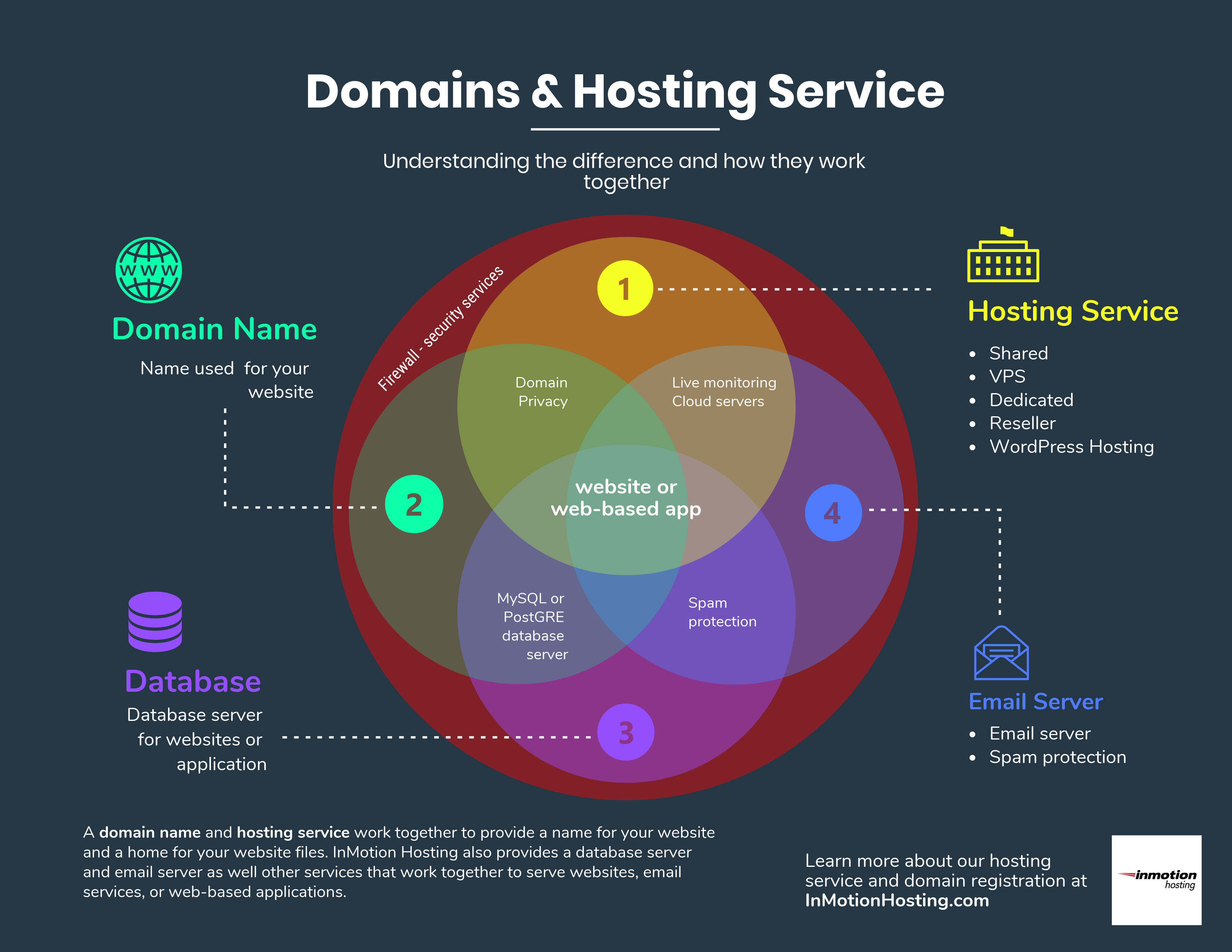
Absolutely, you need both a domain and hosting to establish a successful online presence. Your domain serves as your unique digital address, making it easier for visitors to find and remember your website. Without a domain, your website would be lost in the vast sea of the internet. On the other hand, hosting provides the necessary infrastructure for your website to function smoothly and be accessible to users around the clock. Think of it as the foundation of your online home.
A domain and hosting work hand in hand – the domain directs users to your virtual doorstep, while hosting ensures your website is always open and ready to welcome them in. So, whether you’re launching a personal blog or a business website, having both a domain and hosting is essential to creating a credible and engaging online presence.
The first step in creating any website is to secure your domain name. Once you add a hosting service, you need to update that domain name so it “points” to your web hosting provider. Often, you can purchase a hosting service and a domain name from the same company, which greatly simplifies matters: you not only avoid the need to link the two accounts together, but when it’s time to renew, you can handle everything through the same dashboard.
Have a great idea for a domain name, but you’re not quite ready to get started on design? That’s okay. You can reserve the name at any time, whether or not you have a hosting service lined up, and create your site at a later date.
Can I Change Hosting Companies Later?
Yes. For both website hosting and domain hosting, you can change providers at any time you like. For example, if you purchased web hosting from InMotion Hosting but got your domain name elsewhere, you could easily move your domain name over to make things easier to both manage and renew.
Likewise, you own your domain name, and you can change its settings to point to any hosting provider if you decide to switch to a new company. Moving your files and data should be a seamless process if you are working with a reputable service, and once complete, you just need to update your domain name so it points to the correct location.
Conclusion
In the vast space of web development, it’s important to understand the difference between domain hosting and website hosting. A domain name acts as your virtual compass, guiding visitors to your website’s doorstep, while domain hosting bridges the gap between the name and its technical settings. On the other hand, website hosting forms the backbone of your online presence, providing the platform for your content to shine.
Remember, your domain is your online identity, and hosting is the backbone that keeps your site accessible to the world.
With these pieces of the puzzle in place, you’re ready to create your online presence to start showcasing your ideas, products, or services. Secure your domain and website hosting with InMotion Hosting today, and watch your online dreams come to life.